
A business can have a beautiful website, thousands of social media followers, and even active advertising campaigns—and still struggle to generate customers.
Why?
Because being visible online and growing online are two different things.
Imagine a local business owner who has spent months building an Instagram page, created a professional website, and started running Google Ads. The business looks active everywhere. But website enquiries remain low, advertising costs keep rising, and social media engagement rarely turns into sales.
The problem may not be a lack of online presence. It may be a lack of strategy connecting all those digital activities to an actual business goal.
That is where a digital marketing agency can make a difference.
A strong digital marketing strategy connects search visibility, websites, content, social media, paid advertising, analytics, and conversion optimization into one growth-focused system. Instead of simply asking, “How do we get more people to see this business?”, the better question becomes:
“How do we turn the right online audience into meaningful business results?”
What Does an Online Presence Really Mean?
An online presence is much more than owning a domain name or creating an Instagram account. It is the complete way a business appears, communicates, and interacts with potential customers online.
Think of it as your business’s digital storefront.
Website and Landing Pages
Your website is often where potential customers go after discovering your business through Google, social media, advertisements, or referrals.
A good website should do more than look attractive. It should:
- Clearly communicate what the business offers
- Build trust
- Make navigation simple
- Work well on mobile devices
- Load efficiently
- Encourage visitors to take action
Landing pages can take this further by focusing visitors on one specific objective, such as booking a consultation, requesting a quotation, or submitting an enquiry.
Search Engine Visibility
A website cannot generate much organic business if potential customers cannot find it.
Search engine optimization helps businesses improve their visibility for relevant searches. For example, someone searching for “digital marketing agency in Mumbai” is already demonstrating an interest in a specific service.
Appearing at the right moment can create a valuable opportunity to turn that search into a website visit—and potentially a lead.
Social Media Presence
Instagram, Facebook, LinkedIn, and other platforms give businesses opportunities to communicate directly with their audiences.
Social media can showcase expertise, answer questions, demonstrate products, share customer experiences, and build familiarity before someone is ready to buy.
Online Reputation
Reviews, testimonials, brand mentions, business profiles, and the overall quality of your digital communication influence how people perceive your business.
Trust matters because customers rarely evaluate a company based on one interaction alone.
Paid Advertising
Paid advertising gives businesses another way to reach specific audiences quickly.
Google Ads can put a business in front of people actively searching for relevant products or services, while social advertising can help businesses reach audiences based on characteristics, interests, behaviours, and other targeting signals.
The important point is that these channels should work together, not exist as disconnected activities.
Why Simply Being Online Is No Longer Enough
Many businesses are doing something online. The bigger challenge is making those activities productive.
A business might experience:
- Website traffic without enquiries
- Social media followers without customers
- Google Ads clicks without conversions
- Good content without search visibility
- High advertising costs without clear returns
- Inconsistent branding across platforms
- No reliable conversion tracking
For example, imagine an interior design company receiving 1,000 website visitors every month but only two enquiries.
The answer is not necessarily “We need more traffic.”
The business may need a clearer call-to-action, stronger landing page, better keyword targeting, improved user experience, or more relevant traffic.
This is why digital marketing should be treated as a business growth function, not simply a collection of online tasks.
How Does a Digital Marketing Agency Help a Business Grow?
A digital marketing agency helps businesses connect online visibility with measurable outcomes by combining strategy, content, SEO, advertising, social media, conversion optimization, and analytics. The objective is to attract relevant audiences, turn visits into enquiries or sales, measure performance, and continuously improve the customer journey.
The process can be viewed as:
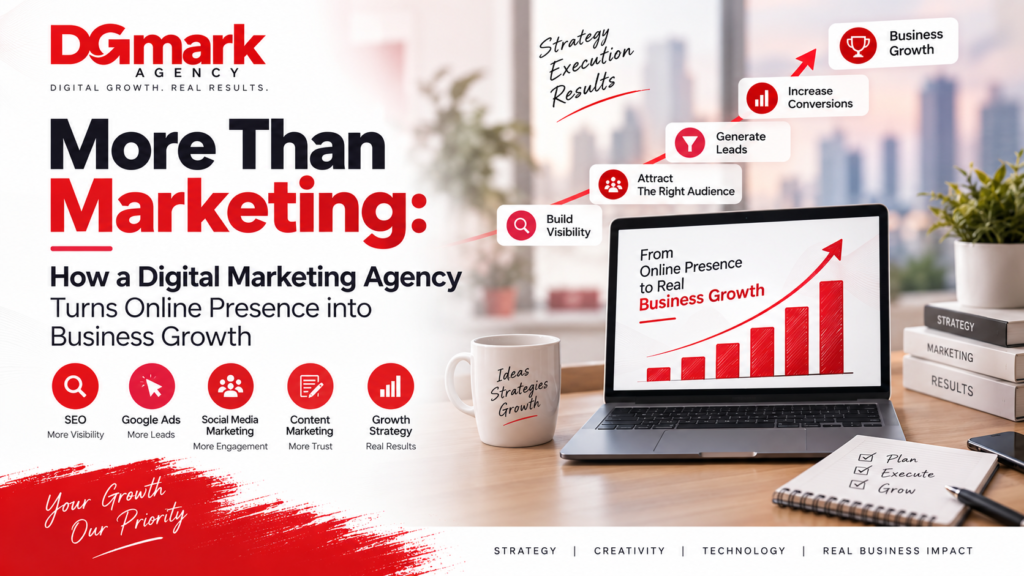
Visibility → Traffic → Engagement → Leads → Conversions → Customers → Growth
Each stage requires a different approach.
Visibility gets your business discovered.
Relevant traffic brings potential customers to your digital channels.
Engagement helps build interest and trust.
Lead generation captures genuine prospects.
Conversion turns prospects into customers.
Measurement and optimization then help improve the entire process.
The Key Digital Marketing Strategies Behind Business Growth
A digital marketing agency for business growth typically brings several disciplines together. The exact mix depends on the business, audience, competition, and objectives.
Search Engine Optimization (SEO)
SEO helps businesses improve their organic visibility on search engines.
Effective SEO is not simply about adding keywords to a page. It involves understanding what people are searching for and creating useful experiences around those searches.
Important areas include:
- Keyword research
- Search intent
- On-page SEO
- Technical SEO
- Content optimization
- Internal linking
- Local SEO
- Link building
Suppose a person searches for “best digital marketing services for small businesses.” A business that has created a genuinely useful page addressing that search has an opportunity to attract a highly relevant visitor.
That is the power of search intent.
SEO can also support long-term organic growth because useful content and well-optimized pages can continue attracting relevant searches over time.
Google Ads and Paid Search
SEO can take time to build. Paid search provides another way to reach potential customers when they are actively searching.
Google Ads can help businesses target relevant searches and direct users to dedicated landing pages.
For example:
Google Search → Relevant Ad → Focused Landing Page → Enquiry Form → Follow-up
The effectiveness of this process depends on factors such as keyword selection, ad relevance, landing-page experience, targeting, budget management, and conversion tracking.
The goal should not simply be to generate clicks. It should be to generate valuable actions.
Social Media Marketing
Social media is more than a place to publish promotional posts.
A well-planned social media strategy can help businesses:
- Build brand awareness
- Demonstrate expertise
- Engage audiences
- Establish credibility
- Generate enquiries
- Build communities
For a service-based business, educational content can answer common customer questions. For an e-commerce brand, product demonstrations and user-generated content can help people understand products before purchasing.
The platform is only the channel. The strategy determines what the business communicates and why.
Content Marketing
Content gives businesses an opportunity to be useful before asking customers to buy.
Blogs, videos, guides, social posts, case studies, FAQs, and educational resources can answer questions throughout the customer journey.
Good content can support:
Discovery → Education → Trust → Consideration → Conversion
Instead of repeatedly telling customers that a company is “the best,” useful content demonstrates knowledge by solving real problems.
Performance Marketing and Lead Generation
Performance marketing focuses heavily on measurable actions.
Depending on the business, these might include:
- Form submissions
- Phone calls
- WhatsApp enquiries
- Purchases
- Bookings
- Registrations
- Downloads
A campaign becomes more useful when a business knows not only how many people interacted with it, but what happened after that interaction.
Analytics and Conversion Optimization
Traffic is only part of the story.
Analytics can help businesses understand where visitors come from, what they do, where they leave, and which channels contribute to conversions.
Conversion optimization can involve:
- Improving landing pages
- Testing headlines
- Strengthening calls-to-action
- Simplifying forms
- Improving page structure
- Testing different messages
The objective is to make the existing traffic more valuable.
Why Businesses Need an Integrated Digital Marketing Strategy
Imagine five people working on the same business.
One handles SEO.
Another runs Google Ads.
Someone else manages Instagram.
A fourth person creates blogs.
Nobody shares data.
The business may technically be doing digital marketing, but the channels are not necessarily working toward the same objective.
An integrated strategy changes this.
For example:
Google Search → Website → Landing Page → Lead Form → Follow-up → Conversion
SEO can bring organic visitors.
Google Ads can capture high-intent searches.
Social media can strengthen brand familiarity.
Content can answer customer questions.
The website can convert visitors.
Analytics can reveal what is working.
This is the difference between doing digital marketing and building a digital marketing system.
How a Digital Marketing Agency Makes the Difference
A professional agency brings more than execution.
Strategy
Before launching campaigns, businesses need clarity about objectives, audiences, positioning, channels, and measurement.
Expertise
SEO, paid advertising, content, social media, websites, analytics, and conversion optimization each require different skills. An agency can bring these capabilities together.
Multi-Channel Execution
Instead of managing every digital channel separately, an agency can coordinate multiple activities around a common objective.
Data Analysis
Marketing decisions become stronger when they are informed by actual performance data rather than assumptions.
Continuous Optimization
Digital marketing is rarely a “set it and forget it” activity. Campaigns, content, landing pages, and targeting can be reviewed and improved based on performance.
Creativity and Consistency
A recognizable brand needs consistent messaging while still producing content that captures attention.
Ultimately, there is a major difference between posting online and building a digital growth strategy.
Posting answers, “What should we publish today?”
Strategy asks, “Why are we publishing this, who is it for, and what business objective should it support?”
Why Choose DGmark Agency?
For businesses looking for professional digital marketing support, DGmark Agency offers a range of services designed to strengthen online visibility and support business growth.
According to its official website, DGmark Agency provides services including website development, SEO, Google Ads, social media marketing, paid social advertising, and complete digital marketing solutions. Its SEO offering includes keyword research, website content and structure optimization, and link-building through content marketing.
The agency states that it was founded in Mumbai in 2016 by Digital Chandan Thakur and describes its approach as combining local market understanding with broader digital marketing strategies. Its website also says the agency has worked with businesses across Mumbai and offers tailored digital solutions.
Another notable aspect is the range of services available under one digital marketing ecosystem. Website development, SEO, paid advertising, and social media can be coordinated rather than treated as completely separate activities.
For a business owner, this integrated approach can be particularly useful when the challenge is not simply “How do I get more visibility?” but “How do I connect visibility with enquiries, conversions, and sustainable growth?”
Businesses can explore DGmark Agency’s services and approach directly through its official website.
What a Successful Digital Marketing Journey Looks Like
There is no universal strategy that works identically for every business. However, a practical digital growth framework can look like this:
Step 1: Understand the Business
Identify the business model, products or services, goals, competitors, existing digital assets, and current challenges.
Step 2: Identify the Target Audience
Understand who the ideal customers are, what problems they have, what they search for, and what influences their decisions.
Step 3: Build or Improve the Digital Foundation
Create or improve the website, landing pages, tracking systems, brand messaging, and conversion paths.
Step 4: Increase Search Visibility
Use SEO to target relevant searches and build useful content around customer intent.
Step 5: Reach the Audience Through Paid and Social Channels
Use Google Ads and social platforms where they make sense for the business and its audience.
Step 6: Generate and Nurture Leads
Make it easy for interested prospects to enquire, book, call, or purchase, and ensure leads receive appropriate follow-up.
Step 7: Track Performance
Monitor the metrics that connect marketing activity to business outcomes.
Step 8: Optimize and Scale
Keep improving campaigns, content, landing pages, targeting, and budgets based on performance.
This process turns digital marketing from a collection of activities into a repeatable growth framework.
Measuring Digital Marketing Success
The right metrics depend on the business objective. Some of the most useful include:
- Website traffic: How many people are visiting your website?
- Organic rankings: How visible are your pages for relevant searches?
- Click-through rate (CTR): How often do people click after seeing an ad or search result?
- Cost per click (CPC): How much does each advertising click cost?
- Cost per lead (CPL): How much is being spent to generate a lead?
- Conversion rate: What percentage of visitors complete the desired action?
- Leads generated: How many potential customers entered the sales process?
- Customer acquisition cost (CAC): How much does it cost to acquire a customer?
- Return on ad spend (ROAS): How much revenue is generated relative to advertising spend?
- Return on investment (ROI): What business return is being generated compared with the investment?
The key is to avoid celebrating a metric simply because it increased.
More website traffic sounds positive—but if the traffic is irrelevant and produces no business value, it may not solve the real problem.
The Future of Digital Marketing: From Visibility to Intelligent Growth
Digital marketing is becoming increasingly connected to data, automation, AI, and personalization.
AI can support marketers with tasks such as content ideation, data analysis, audience research, automation, and campaign workflows. At the same time, search behaviour is changing as users interact with search engines, AI-powered experiences, social platforms, and other discovery channels in different ways.
For businesses, the bigger lesson is not to chase every new tool.
It is to build a marketing system that can adapt.
That means understanding customers, producing useful content, measuring behaviour, improving experiences, and using technology where it genuinely creates value.
The future of digital marketing is therefore less about being present everywhere and more about being relevant at the right moment.
Final Thoughts: Your Online Presence Should Work for Your Business
A website is a starting point.
A social media profile is a starting point.
An advertisement is a starting point.
Real digital growth happens when these elements work together as part of a clear strategy.
The objective is not simply to collect followers, increase impressions, or generate website visits. It is to create a journey where the right people discover your business, understand its value, trust the brand, take action, and eventually become customers.
That is what turns an online presence into a business asset.
For businesses ready to move beyond simply being online and start building a digital presence around measurable growth, DGmark Agency provides an integrated range of digital marketing services, including SEO, Google Ads, social media marketing, paid advertising, website development, and complete digital marketing solutions.
Your digital presence should not just be seen. It should work for your business.