
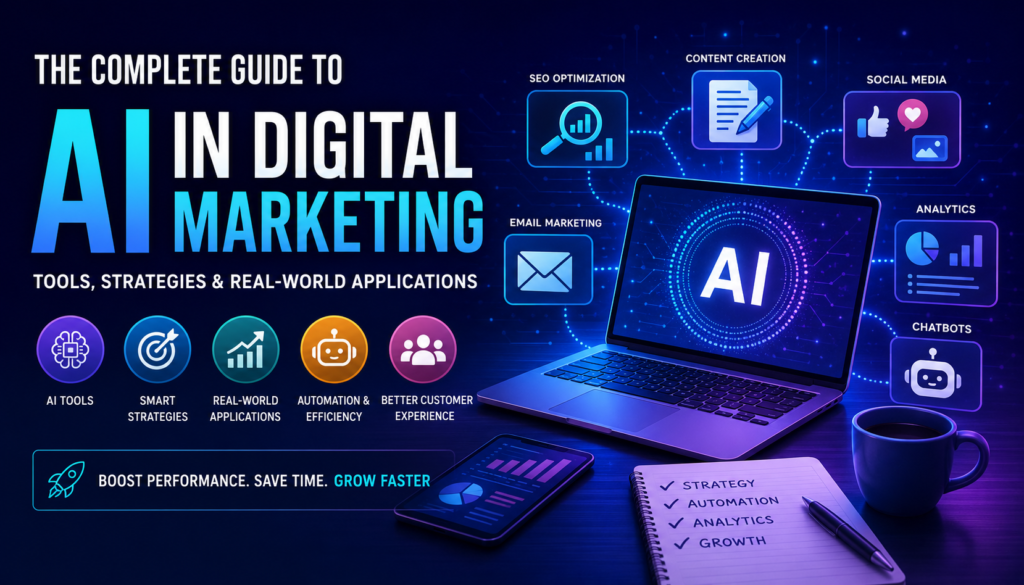
The digital marketing landscape has undergone a dramatic transformation over the past decade. What once relied heavily on manual processes, intuition, and broad audience targeting has evolved into a data-driven ecosystem powered by Artificial Intelligence (AI). Today, businesses of all sizes are leveraging AI in digital marketing to automate repetitive tasks, gain deeper customer insights, improve campaign performance, and deliver personalized experiences at scale.
From content creation and SEO optimization to predictive analytics and customer support, AI is reshaping how marketers interact with audiences. The rapid advancement of generative AI, machine learning, natural language processing (NLP), and automation technologies has made AI-powered marketing more accessible than ever before.
Organizations that effectively combine digital marketing and AI are gaining significant competitive advantages. They can identify customer needs faster, create highly targeted campaigns, improve conversion rates, and maximize marketing ROI while reducing operational costs.
In this comprehensive guide, you’ll learn:
- What AI in digital marketing really means
- How AI works in modern marketing environments
- The benefits and challenges of AI-powered marketing
- The best AI marketing tools available today
- Real-world AI marketing applications and case studies
- How to build an effective AI-driven marketing strategy
- Future trends shaping the future of AI in marketing
Whether you’re a marketer, entrepreneur, business owner, student, or agency professional, this guide will help you understand how artificial intelligence in marketing is transforming the industry.
What is AI in Digital Marketing?
Understanding Artificial Intelligence
Artificial Intelligence (AI) refers to computer systems capable of performing tasks that typically require human intelligence. These tasks include:
- Learning from data
- Recognizing patterns
- Understanding language
- Making predictions
- Solving problems
- Automating decisions
AI technologies are powered by algorithms, machine learning models, and vast amounts of data that enable systems to improve performance over time.
In marketing, AI helps businesses analyze customer behavior, automate workflows, personalize experiences, and optimize campaigns more efficiently than traditional methods.
How AI Works in Marketing
AI in digital marketing operates by collecting and processing large datasets from multiple sources, including:
- Website analytics
- Social media interactions
- Customer purchase history
- CRM systems
- Search behavior
- Email engagement metrics
The AI system identifies patterns and insights that marketers can use to make better decisions.
For example:
| Marketing Activity | Traditional Approach | AI-Powered Approach |
|---|---|---|
| Audience Targeting | Manual segmentation | Predictive segmentation |
| Content Creation | Human-written only | AI-assisted content generation |
| Campaign Optimization | Periodic adjustments | Real-time optimization |
| Customer Support | Human agents | AI chatbots |
| Data Analysis | Manual reporting | Automated insights |
Difference Between Traditional Marketing and AI-Powered Marketing
Traditional marketing relies heavily on assumptions, historical data, and manual decision-making.
AI-powered marketing uses:
- Real-time data processing
- Predictive analytics
- Automation
- Personalization
- Continuous optimization
As a result, businesses can react faster to changing customer behaviors and market conditions.
Why AI is Transforming Digital Marketing
Data-Driven Decision Making
Modern businesses generate enormous amounts of customer data every day. Analyzing this data manually is nearly impossible.
AI analytics tools can:
- Process millions of data points instantly
- Identify trends
- Detect anomalies
- Generate actionable insights
This allows marketers to make evidence-based decisions rather than relying on assumptions.
Personalization at Scale
Consumers increasingly expect personalized experiences.
AI helps brands personalize:
- Product recommendations
- Email campaigns
- Website experiences
- Advertisements
- Social media content
Unlike manual personalization, AI can customize experiences for millions of users simultaneously.
Predictive Analytics
Predictive analytics uses machine learning in marketing to forecast future customer behavior.
Examples include:
- Predicting customer churn
- Forecasting sales
- Identifying purchase intent
- Estimating customer lifetime value
These insights help businesses allocate resources more effectively.
Marketing Automation
AI automation tools streamline repetitive marketing tasks such as:
- Email scheduling
- Lead nurturing
- Social media posting
- Campaign monitoring
- Customer follow-ups
Automation saves time while improving consistency and efficiency.
Improved Customer Experience
AI enables faster and more relevant customer interactions through:
- Chatbots
- Personalized recommendations
- Smart search functions
- Predictive customer support
A better customer experience often leads to higher satisfaction and loyalty.
Key Benefits of AI in Digital Marketing
Increased Efficiency
AI significantly reduces the time required for routine tasks.
Examples include:
- Automated reporting
- Content generation
- Ad optimization
- Audience segmentation
This allows marketing teams to focus on strategic initiatives.
Better Audience Targeting
AI customer segmentation analyzes user behavior and groups audiences based on:
- Interests
- Demographics
- Purchase patterns
- Online activity
This results in highly targeted marketing campaigns.
Enhanced Content Creation
AI content creation tools assist marketers in producing:
- Blog posts
- Social media captions
- Product descriptions
- Ad copy
- Email campaigns
While human oversight remains essential, AI accelerates the content production process.
Improved ROI
AI helps marketers:
- Reduce wasted ad spend
- Improve conversion rates
- Optimize budgets
- Increase customer retention
The result is a stronger return on marketing investment.
Faster Campaign Optimization
Traditional optimization may take days or weeks.
AI-powered marketing platforms can:
- Analyze performance continuously
- Adjust bids automatically
- Reallocate budgets
- Improve targeting in real time
This enables campaigns to perform more effectively.
Top AI Tools Used in Digital Marketing
AI Content Writing Tools
ChatGPT
What it does:
Generates content, ideas, outlines, and marketing copy.
Key Features:
- Blog writing assistance
- Content ideation
- Email creation
- SEO content support
- Research assistance
Best Use Cases:
- Content marketing
- Copywriting
- Customer support scripts
Pros:
- Fast content generation
- Versatile
- Easy to use
Limitations:
- Requires human fact-checking
- May produce generic content without proper prompting
Jasper
What it does:
AI content platform designed specifically for marketers.
Key Features:
- Brand voice customization
- Marketing templates
- Long-form content generation
Pros:
- Marketing-focused
- Strong collaboration features
Limitations:
- Subscription cost
AI SEO Tools
Surfer SEO
What it does:
Optimizes content based on SERP data.
Key Features:
- Content scoring
- NLP keyword suggestions
- Competitor analysis
Best Use Cases:
- Blog optimization
- On-page SEO
Pros:
- Data-driven recommendations
Limitations:
- Learning curve for beginners
Clearscope
What it does:
Improves content relevance and search visibility.
Key Features:
- Content grading
- Keyword optimization
- Search intent alignment
Pros:
- Excellent content optimization
Limitations:
- Premium pricing
AI Social Media Tools
Buffer AI Assistant
What it does:
Creates and optimizes social media content.
Key Features:
- Caption generation
- Scheduling
- Performance tracking
Pros:
- Easy workflow integration
Limitations:
- Limited advanced AI capabilities
Hootsuite AI
Best For:
- Enterprise social media management
- Content scheduling
- Social listening
AI Email Marketing Tools
Mailchimp AI
Features:
- Predictive segmentation
- Subject line optimization
- Automated journeys
Pros:
- User-friendly
Limitations:
- Advanced features require higher plans
HubSpot AI
Features:
- Smart personalization
- Lead nurturing
- Automated workflows
AI Analytics and Reporting Tools
Google Analytics 4 (GA4)
Features:
- Predictive metrics
- Event-based tracking
- Customer journey analysis
Tableau AI
Features:
- Advanced data visualization
- Predictive analytics
- Automated insights
AI Chatbots and Customer Support Tools
Intercom
Features:
- AI customer support
- Automated responses
- Lead qualification
Drift
Features:
- Conversational marketing
- AI-powered lead generation
- Personalized customer engagement
AI Applications in Digital Marketing
AI for Content Marketing
AI content creation is transforming content marketing workflows.
Marketers use AI to:
- Generate blog outlines
- Create first drafts
- Develop content briefs
- Identify content gaps
- Optimize readability
However, the best results occur when human expertise enhances AI-generated content.
AI for SEO
AI for SEO helps marketers improve search visibility through:
- Keyword research
- Content optimization
- SERP analysis
- Internal linking recommendations
- Technical SEO audits
Modern AI SEO tools enable faster optimization while maintaining quality.
AI for PPC Advertising
AI marketing applications in paid advertising include:
- Smart bidding
- Audience targeting
- Ad copy testing
- Budget optimization
- Conversion prediction
Platforms like Google Ads increasingly rely on AI-powered algorithms to improve performance.
AI for Email Marketing
AI email marketing enhances:
- Personalization
- Send-time optimization
- Subject line generation
- Audience segmentation
- Automated workflows
This often results in higher open and conversion rates.
AI for Social Media Marketing
AI for social media marketing helps businesses:
- Schedule content
- Analyze engagement
- Identify trends
- Generate captions
- Optimize posting times
Social media teams can scale content production significantly with AI assistance.
AI for Customer Service
AI chatbots provide:
- 24/7 support
- Instant responses
- Lead qualification
- Customer onboarding
This reduces response times and improves customer satisfaction.
AI for Conversion Rate Optimization
AI analyzes user behavior to identify conversion barriers and recommend improvements.
Examples include:
- Heatmap analysis
- Personalized landing pages
- A/B testing automation
- Behavioral targeting
These capabilities help increase conversions without increasing traffic.
Real-World Applications and Case Studies
Understanding AI marketing concepts is important, but seeing how businesses apply them in real-world scenarios demonstrates the true power of AI-powered marketing.
E-commerce Brands Using AI
E-commerce companies are among the biggest adopters of AI in digital marketing because they generate massive amounts of customer data daily.
AI helps online retailers:
- Personalize shopping experiences
- Improve product discovery
- Optimize pricing strategies
- Automate customer support
- Predict customer purchasing behavior
Some of the most successful e-commerce brands use AI to increase customer retention and improve conversion rates.
Common AI Applications in E-commerce
| Application | Benefit |
|---|---|
| Product Recommendations | Increased average order value |
| Dynamic Pricing | Improved profitability |
| AI Chatbots | Better customer support |
| Predictive Analytics | Improved inventory planning |
| Customer Segmentation | Higher marketing ROI |
AI in Personalized Recommendations
Recommendation engines have become one of the most visible AI marketing applications.
These systems analyze:
- Browsing history
- Purchase behavior
- Search patterns
- User preferences
- Similar customer actions
The goal is to present users with products, services, or content they are most likely to engage with.
Benefits of AI Recommendations
- Increased customer engagement
- Higher conversion rates
- Better user experience
- Improved customer retention
- More repeat purchases
Personalization has become a competitive necessity rather than a luxury.
AI-Powered Advertising Examples
Modern advertising platforms use machine learning in marketing to improve campaign performance.
Examples include:
Google Performance Max
Uses AI to:
- Optimize targeting
- Adjust bids automatically
- Predict conversions
- Allocate budgets
Meta Advantage+
Uses AI to:
- Identify high-performing audiences
- Test creative combinations
- Improve campaign efficiency
These systems continuously learn from user behavior and optimize performance in real time.
AI Chatbot Success Stories
AI chatbots are transforming customer communication.
Businesses use chatbots to:
- Answer FAQs
- Handle support requests
- Qualify leads
- Schedule appointments
- Guide customers through sales funnels
Benefits of AI Chatbots
- 24/7 availability
- Reduced support costs
- Faster response times
- Improved customer satisfaction
- Increased lead generation
Content Marketing Case Studies
AI content creation is increasingly becoming part of content marketing workflows.
Many organizations use AI to:
- Generate content briefs
- Identify keyword opportunities
- Create first drafts
- Optimize content for SEO
- Repurpose content across channels
Successful brands combine AI-generated efficiency with human creativity and expertise.
How to Build an AI-Powered Digital Marketing Strategy
Implementing AI successfully requires a structured approach.
Define Business Goals
Before adopting any AI marketing tools, clearly identify your objectives.
Examples include:
- Increasing website traffic
- Generating more leads
- Improving conversion rates
- Reducing customer acquisition costs
- Enhancing customer retention
Without clear goals, measuring AI success becomes difficult.
Identify Marketing Challenges
Determine which marketing processes need improvement.
Common challenges include:
- Content production bottlenecks
- Poor campaign performance
- Limited personalization
- Manual reporting
- Inefficient lead management
AI should solve specific business problems rather than being implemented simply because it is trendy.
Select the Right AI Tools
Not every AI tool fits every business.
Evaluate tools based on:
- Business needs
- Budget
- Integration capabilities
- Ease of use
- Scalability
AI Tool Selection Checklist
- Does it solve a real problem?
- Is it easy to implement?
- Can it integrate with existing systems?
- Does it provide measurable ROI?
- Is customer support available?
Implement Automation
Start by automating repetitive tasks.
Examples include:
- Email sequences
- Social media scheduling
- Lead nurturing
- Reporting
- Customer support
Gradual implementation minimizes risk and improves adoption.
Measure Performance
Track KPIs before and after AI implementation.
Important metrics include:
- Traffic growth
- Conversion rate
- Customer acquisition cost
- Return on ad spend
- Customer lifetime value
- Email engagement
Data-driven evaluation helps determine whether AI investments are delivering value.
Continuously Optimize
AI systems improve over time, but they require monitoring and refinement.
Regularly:
- Review performance
- Update workflows
- Train teams
- Test new features
- Refine prompts and processes
Continuous optimization is essential for long-term success.
Challenges and Limitations of AI in Marketing
While AI offers significant advantages, it is not without limitations.
Data Privacy Concerns
AI systems rely heavily on data.
Organizations must comply with privacy regulations and ensure responsible data collection practices.
Key considerations include:
- User consent
- Data security
- Transparency
- Regulatory compliance
Maintaining customer trust should remain a top priority.
Ethical Considerations
Artificial intelligence raises several ethical concerns.
Examples include:
- Algorithmic bias
- Lack of transparency
- Manipulative personalization
- Data misuse
Marketers should establish ethical guidelines for AI deployment.
Overdependence on Automation
Automation increases efficiency but excessive reliance can create problems.
Potential risks include:
- Reduced human oversight
- Missed strategic opportunities
- Generic customer experiences
- Brand inconsistency
AI should support marketers, not replace strategic thinking.
Content Quality Risks
Generative AI marketing tools can produce:
- Inaccurate information
- Outdated facts
- Generic content
- Repetitive messaging
Every AI-generated asset should undergo human review before publication.
Human Creativity vs AI
AI excels at:
- Pattern recognition
- Data analysis
- Automation
Humans excel at:
- Creativity
- Emotional intelligence
- Storytelling
- Strategic decision-making
The strongest marketing results come from combining both capabilities.
Future of AI in Digital Marketing
The future of AI in marketing is evolving rapidly.
Businesses that adapt early will be better positioned to compete in increasingly digital environments.
Emerging AI Trends
Several trends are expected to shape the next generation of marketing.
These include:
- Advanced personalization
- Autonomous marketing systems
- AI-generated multimedia
- Predictive customer journeys
- Real-time optimization
Generative AI
Generative AI marketing is one of the fastest-growing segments of artificial intelligence.
Capabilities include:
- Content generation
- Image creation
- Video production
- Audio generation
- Marketing asset creation
Generative AI is dramatically reducing content production time.
Predictive Marketing
Predictive marketing uses AI analytics tools to forecast future behavior.
Applications include:
- Lead scoring
- Purchase prediction
- Churn forecasting
- Revenue forecasting
Predictive insights enable proactive marketing decisions.
Hyper-Personalization
Traditional personalization targets audience segments.
Hyper-personalization targets individuals.
AI enables:
- Individualized recommendations
- Personalized messaging
- Dynamic website content
- Customized offers
Consumers increasingly expect these experiences.
Voice and Visual Search
Search behavior is changing.
Users now search using:
- Voice assistants
- Image recognition
- Smart devices
Marketers must optimize content for:
- Conversational queries
- Visual search engines
- Voice search experiences
These channels are expected to continue growing.
AI Agents and Autonomous Marketing
AI agents represent the next stage of marketing automation.
Future AI systems may independently:
- Launch campaigns
- Optimize budgets
- Create content
- Analyze results
- Recommend strategic actions
Human oversight will remain important, but autonomous marketing systems will become increasingly common.
Best Practices for Using AI in Marketing
Maintain Human Oversight
Always review AI-generated outputs.
Human oversight ensures:
- Accuracy
- Brand consistency
- Compliance
- Strategic alignment
AI should augment human expertise rather than replace it.
Focus on Data Quality
AI performance depends on data quality.
Best practices include:
- Cleaning datasets regularly
- Removing duplicates
- Updating customer information
- Maintaining accurate tracking
High-quality data produces better AI outcomes.
Use AI Ethically
Responsible AI adoption should prioritize:
- Transparency
- Fairness
- Privacy
- Accountability
Ethical marketing strengthens long-term customer relationships.
Balance Automation with Creativity
Automation improves efficiency.
Creativity drives differentiation.
Successful brands combine:
- AI-driven efficiency
- Human storytelling
- Strategic thinking
- Authentic brand communication
Continuously Test and Improve
Marketing environments constantly evolve.
Regularly test:
- AI prompts
- Campaign strategies
- Automation workflows
- Content formats
- Audience segments
Continuous improvement ensures sustained performance gains.
Frequently Asked Questions (FAQ)
1. What is AI in digital marketing?
AI in digital marketing refers to the use of artificial intelligence technologies to automate tasks, analyze data, personalize customer experiences, and improve marketing performance.
2. How is AI used in marketing?
AI is used for:
- Content creation
- SEO optimization
- Advertising
- Email marketing
- Customer support
- Analytics
- Personalization
3. What are the best AI marketing tools?
Popular AI marketing tools include:
- ChatGPT
- Jasper
- Surfer SEO
- Clearscope
- HubSpot AI
- Mailchimp AI
- Intercom
- Drift
4. Can AI replace digital marketers?
No.
AI can automate many tasks, but human marketers remain essential for strategy, creativity, leadership, and decision-making.
5. How does AI help SEO?
AI for SEO helps with:
- Keyword research
- Content optimization
- Competitor analysis
- Technical audits
- Search intent analysis
6. Is AI-generated content good for SEO?
AI-generated content can support SEO when it is:
- Accurate
- Helpful
- Original
- Human-reviewed
- Search intent focused
Publishing unedited AI content may negatively impact quality.
7. What is machine learning in marketing?
Machine learning in marketing refers to systems that learn from data and improve performance over time without explicit programming.
Examples include recommendation engines and predictive analytics.
8. How does AI improve email marketing?
AI email marketing improves:
- Personalization
- Subject lines
- Audience segmentation
- Send-time optimization
- Automation
These improvements often increase engagement rates.
9. What are the risks of using AI in marketing?
Potential risks include:
- Data privacy concerns
- Biased outputs
- Inaccurate information
- Over-automation
- Reduced human creativity
Proper governance minimizes these risks.
10. What skills should marketers learn for AI?
Future-ready marketers should develop skills in:
- Prompt engineering
- Data analysis
- AI tool management
- Marketing automation
- SEO
- Content strategy
- Analytics interpretation
11. What is generative AI marketing?
Generative AI marketing involves using AI systems to create content such as text, images, videos, emails, advertisements, and marketing assets.
12. What is the future of AI in marketing?
The future of AI in marketing will likely include:
- Hyper-personalization
- Autonomous marketing systems
- Predictive customer journeys
- AI agents
- Voice search optimization
- Advanced generative AI capabilities
Conclusion
Artificial intelligence is no longer a futuristic concept—it is a core component of modern marketing success. Businesses that effectively combine digital marketing and AI can improve efficiency, enhance personalization, optimize campaigns, and deliver superior customer experiences.
From AI content creation and AI-powered marketing automation to predictive analytics and intelligent customer segmentation, the opportunities are extensive. However, successful implementation requires more than simply adopting tools. Organizations must establish clear objectives, maintain high-quality data, uphold ethical standards, and ensure ongoing human oversight.
The most successful marketers of 2026 and beyond will not be those who rely entirely on AI or entirely on human expertise. Instead, they will be those who effectively combine the speed, scalability, and intelligence of AI with the creativity, empathy, and strategic thinking of human professionals.
As AI continues to evolve, businesses that begin integrating artificial intelligence into their marketing strategies today will be better positioned to compete, innovate, and grow in an increasingly digital future.